
I pulled 16 years of City of Boston ERT/New Construction Permit Data, Here's What I Found..
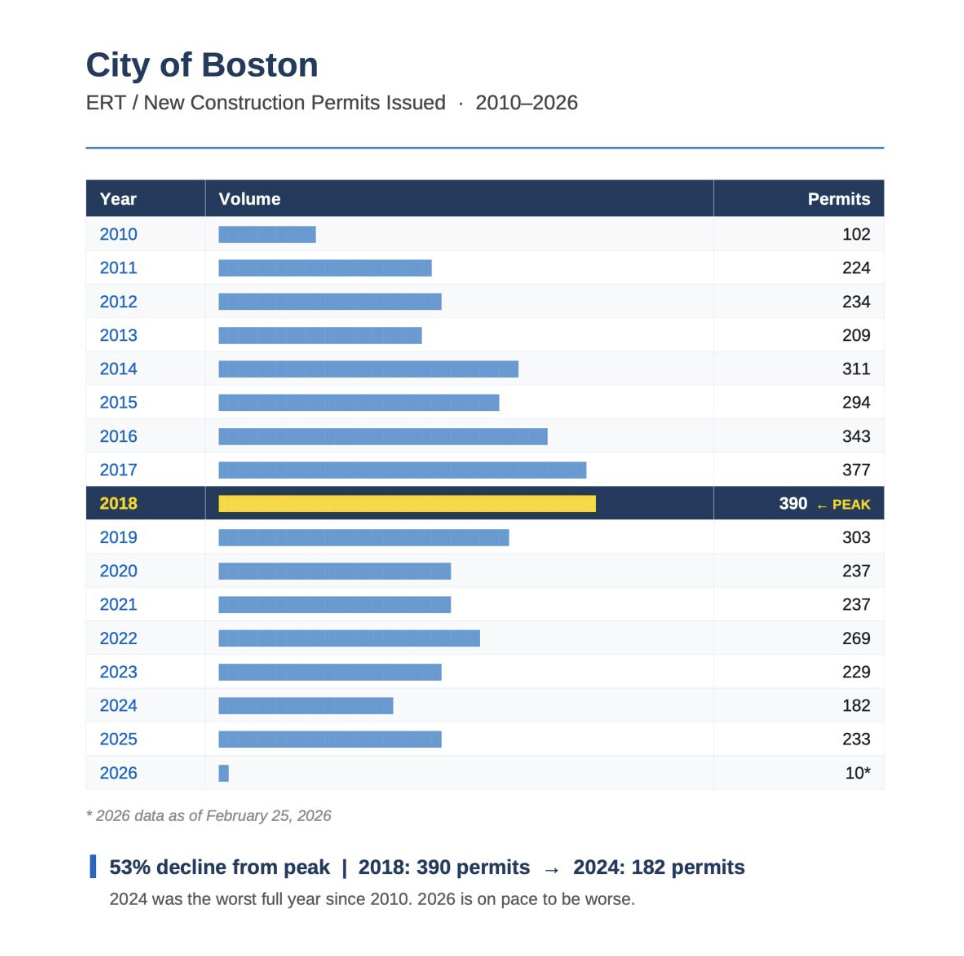
I pulled 16 years of City of Boston ERT/New Construction permit data, and the numbers are sobering.
Peak year: 2018: 390 permits issued. 2024: 182 permits. That's a 53% decline from peak.
A seasoned permit expeditor I spoke with last week put it bluntly: "New construction has fallen off a cliff in the city."
The data backs him up. The cranes are gone. After peaking in 2018, Boston hasn't come close to those levels. 2024 was the worst full year since 2010, back when the city was still crawling out of a financial crisis.
So what's driving this?
Two words keep coming up: linkage fees and IDP requirements (Inclusionary Development Policy). Boston currently requires new residential projects to have a heavy affordable component, and linkage fees on commercial development have increased significantly over the past several years. Add in higher interest rates, elevated construction and energy cost requirements, and a NIMBY-friendly appeals process, and the pencil gets thrown away.
You can mandate affordability in every building that gets built, but if fewer units get built, the city still loses. 2026 could be on pace for a year like 2010 when there were only 110 permits issued. Even accounting for seasonal lag in early-year permitting, the trajectory is hard to spin positively.
Boston is one of the most supply-constrained housing markets in the country. We all know this. The cost of inaction shows up every month in rents and sale prices that price out another generation of residents. The conversation needs to continue to evolve from "how do we extract more from each project" to "how do we simply get more projects off the ground and quickly."
Data source: City of Boston ERT/New Construction Permit Issuance, 2010–2026
bostonrealestate cre multifamily newconstruction
Peak year: 2018: 390 permits issued. 2024: 182 permits. That's a 53% decline from peak.
A seasoned permit expeditor I spoke with last week put it bluntly: "New construction has fallen off a cliff in the city."
The data backs him up. The cranes are gone. After peaking in 2018, Boston hasn't come close to those levels. 2024 was the worst full year since 2010, back when the city was still crawling out of a financial crisis.
So what's driving this?
Two words keep coming up: linkage fees and IDP requirements (Inclusionary Development Policy). Boston currently requires new residential projects to have a heavy affordable component, and linkage fees on commercial development have increased significantly over the past several years. Add in higher interest rates, elevated construction and energy cost requirements, and a NIMBY-friendly appeals process, and the pencil gets thrown away.
You can mandate affordability in every building that gets built, but if fewer units get built, the city still loses. 2026 could be on pace for a year like 2010 when there were only 110 permits issued. Even accounting for seasonal lag in early-year permitting, the trajectory is hard to spin positively.
Boston is one of the most supply-constrained housing markets in the country. We all know this. The cost of inaction shows up every month in rents and sale prices that price out another generation of residents. The conversation needs to continue to evolve from "how do we extract more from each project" to "how do we simply get more projects off the ground and quickly."
Data source: City of Boston ERT/New Construction Permit Issuance, 2010–2026
bostonrealestate cre multifamily newconstruction
Categories
Recent Posts

What Are People Sleeping on in the South Boston Real Estate Market?
Southie Market Update: The Shift is Real
South Boston Investment Property Reset
Is the Real Estate Market Finally Thawing?
The Fed Can Cut Rates and Real Estate Can Still Feel Worse
Southie 2026: what we’re watching, and taking action on.

Are We Living Through the Greatest Bubble(s) of All Time?
South Boston Real Estate 2026 Forecast

Good News in a Tough Real Estate Market